

IN-FAME RESEARCH PROJECT
IN-SITU REINFORCED Fe-Al MMCs FOR ADDITIVE MANUFACTURING
In the IN-FAME research project, we are working with Esslingen University of Applied Sciences to develop an Fe-Al-based metal matrix composite for additively manufactured high-temperature components. The aim is to form finely dispersed reinforcement particles directly within the material. To achieve this, we coordinate alloy design, powder production, and laser powder bed fusion (L-PBF). Our goal is an integrated process route from metal powder to functional demonstrator that also considers the recycling of residual material.
2026–2028
Project duration
Fe-Al-MMC
Material development
VIGA + L-PBF
Integrated process route
ALLOY CONCEPT AND POWDER DEVELOPMENT
The iron-aluminium matrix is intended to provide the basis for a material that withstands mechanical loading at elevated temperatures and in oxidizing atmospheres. We are investigating how finely dispersed oxide or carbide particles can stabilize the microstructure and improve high-temperature strength. The aluminium content is intended to support the formation of a protective aluminium oxide layer.
REINFORCEMENT FORMS WITHIN THE MATERIAL
The reinforcement phases are intended to form in situ, without separately adding pre-manufactured ceramic nanoparticles. We are investigating two development routes to achieve the most uniform possible particle distribution and effective integration of the particles into the metallic matrix.
| Development route | Approach |
| Oxide reinforcement | Controlled formation of yttrium oxide particles (Y₂O₃) through coordinated alloy design, controlled passivation, and L-PBF processing. |
| Carbide reinforcement | Initiating carbide formation within VIGA production and investigating subsequent particle and microstructure development throughout the process chain. |
We develop the powders using Vacuum Induction Gas Atomization (VIGA). Alloy composition, melt processing, crucible material, and atomization conditions are coordinated. The focus is on reproducible powder quality, suitable particle sizes, and reliable L-PBF processability.
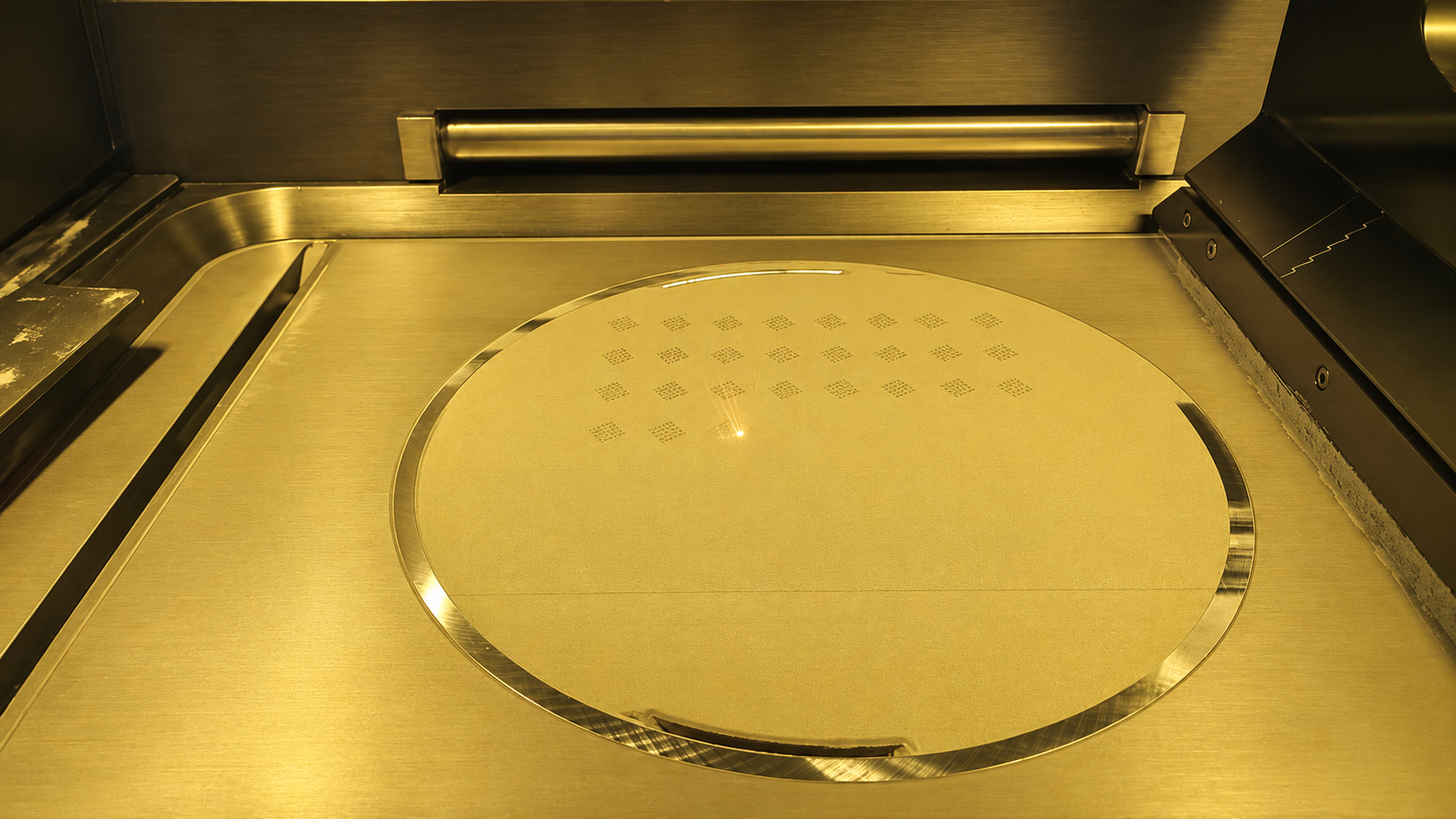
Inside the L-PBF build process on the TRUMPF TruPrint 3000
FROM METAL POWDER TO FUNCTIONAL DEMONSTRATOR
The Laboratory for Additive Manufacturing (L3D) at Esslingen University of Applied Sciences is investigating the processing of the new powders on a TRUMPF/ATLIX TruPrint 3000. Development covers powder spreading behavior, laser exposure parameters, and the relationships between processing conditions, microstructure, and component properties.
PROJECT DEVELOPMENT AND RESEARCH OBJECTIVES
| Focus area | Development objective |
| Powder and process stability | Reproducible composition, suitable particle morphology and flowability, and uniform powder spreading. |
| Additive processing | A robust L-PBF process window for dense test specimens with few defects, and transfer to more complex functional demonstrators. |
| High-temperature behavior | Evaluation of strength, ductility, microstructural stability, and oxidation resistance. The target service temperature range is 600–850 °C. |
| Heat treatment | Investigation of the effects on reinforcement particles, precipitate growth, and microstructure development. |
MATERIAL RECYCLING
The project aims to characterize and reprocess residual fractions from atomization and scrap from additive manufacturing, returning them to powder production. We are investigating how repeated recycling affects composition, powder quality, and component properties.
PROJECT PARTNERS AND RESPONSIBILITIES
MTS METAL POWDER GMBH & CO. KG
We are responsible for the alloy concept and the materials and process engineering fundamentals of powder production. This includes selecting and preparing raw materials, adapting the VIGA process, passivation, and powder characterization. We also investigate the return of residual fractions and scrap to the manufacturing process.
ESSLINGEN UNIVERSITY OF APPLIED SCIENCES
Laboratory for Additive Manufacturing (L3D) · Faculty of Mechanical and Systems Engineering
Our research partner develops and optimizes the L-PBF process for the new Fe-Al MMCs. L3D investigates powder rheology, manufactures test specimens and functional demonstrators, and analyses their mechanical and metallurgical properties. Microstructural analysis, heat treatments, and high-temperature oxidation tests complement the qualification work.
POTENTIAL APPLICATIONS
The project targets future applications in AM components exposed to thermal and mechanical loads, such as heat exchangers and components for energy and process engineering. Representative functional demonstrators are intended to show how the material concept can be applied to practical geometries. Suitability for individual applications will be assessed on the basis of the project results.
PROJECT DETAILS AND FUNDING PROGRAMME
| Project | IN-FAME |
| Research topic | Development of in-situ reinforced Fe-Al metal matrix composites |
| Duration | 1 July 2026 to 30 June 2028 |
| Funding programme | Invest BW – Innovation IV |